

So begins my journey of turning an “invasive weed” into a most delicious pesto that goes great on anything you’d put pesto on!
I have been doing my fair share of yard and field foraging lately, and the past couple of weeks these stalks have been popping up in the yard. After a very short web search, I discovered that they are an edible green that was brought over from Europe as a food source, but on this continent it has become an invasive species. It even emits certain chemicals into the soil that it lives in that make it inhospitable to most other plants. Yet, in moderation, this plant is totally edible – even the root (please do your own research before consuming any wild plant, even if edible, for possible side effects or contraindications). It has a slightly, well, garlicky taste. I think that is much easier on the palate than dandelion greens, who in my yard don’t grow too far away.

The idea when harvesting Garlic Mustard is to take up the whole plant. If you don’t, eventually you’ll have quite the, um… crop on your hands. It’s plentiful and invasive: rip it out by the root.

I’m not using the roots for anything yet – they are just drying. I’ll probably accumulate them en masse slowly, and then make something later. Perhaps a tea, or a root granola bar. We’ll see.

The plant has these beautiful little white flowers that go into the recipe just the same as the leaves, which are picked off the main stems (which go into my compost heap).
I admit that I often do NOT wash greens or produce (just like if I were to eat it right in the garden), especially if there is no dirt on. These, though, especially being ripped out by the root, need a good washing. And there is something about how a little bit of water can “freshen” some vegetables. Others, though, too much washing can wilt them. In this case, the leaves are pretty hardy, but you can see a bit of wilting.

And because Pesto is an oil-base sauce with no water added, it’s best to get all of the water off. So, this is my “towel trick.” Though it isn’t so much a trick, as a method. I lay the washed leaves on a kitchen towel, then roll, and let sit for a minute or two.

So, here we go. Greens, then walnuts.

Now is a good time to tell you that I combined about a 1/2 cup of Cilantro Mucho pesto that I made prior, into this. So this actually is a Cilantro-Garlic Mustard Pesto. But, effectively, you can use, or mix in, any pesto variety you already have. It just so happened that I already had old pesto in the fridge when it was time to make this, and keeping my Experiments condensed and under control in the fridge is a balancing act. I regularly combine multiple smaller bits of things that are pretty much the same. So, this also contains Garlic, from before.
Here you can see the jar that held the old pesto, and that would hold the new mixture as well. Observe my workspace, with my favorite all-stage-except-for eating utensil, the rubber spatula:

I also included this super cool wild chive I ripped out from the field:

I had chopped that, but the picture went MIA. You can guess what it looked like. Lush!
I don’t use measurements – just keep adding oil until it’s the right consistency.
So, at some point, after blending the greens, walnuts, oil, and chives (and salt to taste), it can look like this:

Or this, after separating a bit:

I love my spatulas so much. I do my best to scrape every last bit out.

You may say it doesn’t make that much of a difference, but look at how much I got from scraping, that just would have gone down the drain:

Sort of hard to tell in a wide-ish bowl, but that’s probably a good few tablespoons: not quite a half cup, yet still a substantial amount of sauce. But not enough for me! So I pour more on top, of course.

I kept pouring until what remained juuuust filled to the top of the jar. How about that for “it all works out” huh? That’s what happens when you don’t waste any. You get a full jar of pesto.


Yum.
Here’s what it looks like stirred up.

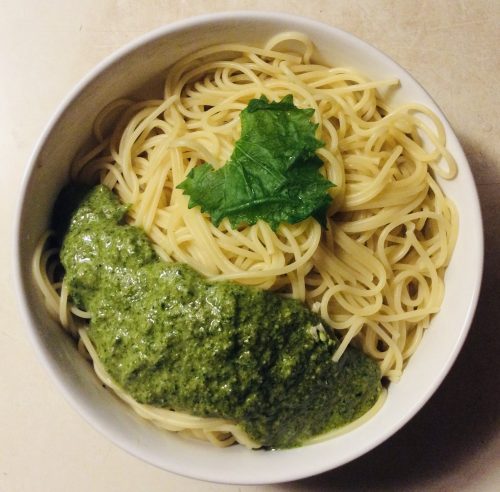
It’s hard to make pesto and NOT have pasta. I was intending to do a grain-free cleanse, but it hasn’t quite come to pass yet. Oh well. This is pretty much as healthy as you can make dried semolina pasta, IMHO. But this would also be great as a dip (at room temp), a drizzle or dressing (if more oil is added), or however! I’ll admit sometimes I eat it straight. Whatever floats your fleck!
Leave a Reply